Understand the Technology
What is an ASIC?
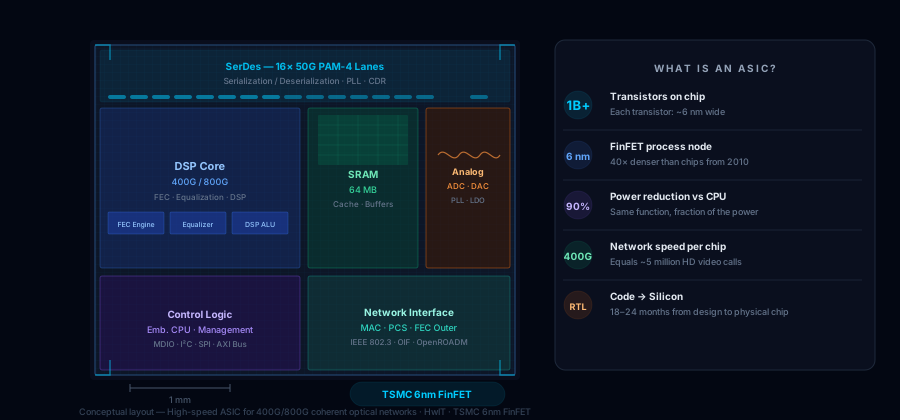
ASIC stands for Application-Specific Integrated Circuit — a chip designed from scratch to perform one specific function with maximum efficiency. Unlike a general-purpose processor that does everything reasonably well, an ASIC does one thing extraordinarily well.
ASIC vs CPU: what's the difference?
Imagine you need to slice bread. A chef's knife works — but a professional bread slicer is incomparably faster, more precise, and more efficient. Your computer's CPU is the chef's knife: versatile, but generic. The ASIC is the slicer: built for one purpose, unbeatable at it.
In practice, an ASIC for 400G/800G optical networks processes digital signals at speeds no conventional processor could match — with 10× lower power consumption and in a chip the size of a fingernail. It's the heart of the routers and transponders that move the global internet.
Where are ASICs in the real world?
- Telecom networks: 400G/800G transponders that carry all internet traffic between continents and data centers.
- Artificial Intelligence: GPUs and TPUs — like those from NVIDIA and Google — are ASICs optimized for neural network matrix multiplication.
- Smartphones: the camera chip, 5G modem, and security processor are all different ASICs inside your phone.
- Scientific instrumentation: CERN detectors, space telescopes, and medical CT scanners use custom ASICs to process signals in real time.
RTL Design
Everything starts with code. Engineers describe chip behavior in languages like SystemVerilog — the "software" that becomes hardware.
Synthesis & Place-and-Route
The code is converted into billions of transistors positioned nanometrically on silicon. A process with over 50 EDA steps.
Fabrication (Tapeout)
The final GDSII goes to the foundry (e.g., TSMC 6nm). Hundreds of lithographic steps etch the patterns into silicon with atomic precision.
Silicon Validation
The first physical chip is tested and validated. HwIT takes chips from RTL to functional silicon with a proven track record from 28nm to 6nm.
 |
|